
How to send negatives safely by post
Contents
- Why sending negatives safely deserves careful attention
- The best packaging materials for negatives: a checklist
- Step by step: packing and posting negatives
- Insured and signed-for shipping: when do you need it?
- Shipping risks and how to reduce them
- Storing negatives: from shipping to archiving
- What happens on arrival: film developing by post
- Common mistakes when posting negatives
- Frequently asked questions
Last updated: 6 September 2026
Why sending negatives safely deserves careful attention
Your negatives are the originals. Once they are damaged or lost, no scan or print can replace all the information in the film itself. Sending this delicate material is understandably a concern for many photographers.
Sending negatives safely by post starts with preparation. It is not just about choosing an envelope: you need protection against moisture, pressure, bending and dust throughout the journey. Packaging should protect its contents against normal handling during postal sorting.

This guide covers every step, from choosing packaging to considering insured shipping. A few simple precautions can significantly reduce the risks, although no shipping method can eliminate them entirely.
The best packaging materials for negatives: a checklist
This section explains how to choose materials that address the practical risks of postal handling in the Netherlands.
The key question is not how expensive the materials are, but whether they will withstand the journey through a sorting centre. Choose packaging for its protective properties rather than convenience alone.
Protective sleeves: archival materials matter
The first layer is the protective sleeve. Ordinary PVC sleeves can contain plasticisers that may migrate to the film surface and cause permanent chemical damage (loc.gov). Choose suitable photographic sleeves made from polypropylene (PP) or polyester (PET). Look for materials intended for photographic archival storage; a generic 'acid-free' label alone does not describe every aspect of suitability.
One widely used option is a Print File archival sleeve. Choose a sleeve designed for your film format and follow its storage guidance. No sleeve can make damp negatives safe to store; film must be fully dry.
Outer packaging: cardboard envelope or box?
The second layer is rigid outer packaging. Two common options are:
-
A sturdy cardboard envelope: this can suit a small number of developed strips, provided it is genuinely rigid. Choose substantial cardboard, for example at least 300 g/m², with corrugated reinforcement. Leave about 2 cm of clearance around the sleeves so the film is not held under tension. Card weight alone does not guarantee bending resistance.
-
A small box (for example, 20 × 15 × 5 cm): a box is preferable for larger batches, 4 × 5 inch sheet film, or rolls in protective containers. It resists concentrated pressure better. Fill empty space without compressing the film, using air cushions or paper cushioning rather than loose foam that may shed particles.
The moisture barrier: an outer mailing bag
The third layer protects against moisture. Cardboard is not waterproof. A simple option is to place the rigid package inside a plastic mailing bag (poly mailer). Choose a bag larger than the envelope so you do not have to stretch it tightly.
Another option is a water-resistant polypropylene mailing envelope as the outer layer. It is less rigid than cardboard, so additional rigid support is still needed inside.
Shopping checklist
Use this list when buying your materials:
- Protective sleeve: photo-safe polypropylene (PP) or polyester (PET), not PVC. Choose the correct size, such as a sleeve for a 35mm strip of six frames.
- Rigid support: substantial cardboard, for example 2 mm thick, or a reinforced corrugated mailing envelope.
- Cushioning: bubble wrap or an additional protective cardboard layer around the sleeved and supported film.
- Outer layer: a water-resistant mailing bag or a purpose-made protective mailing envelope.
- Closure: wide packaging tape over outer seams and openings. Keep tape away from the film and do not use string or elastic bands.
Step by step: packing and posting negatives
Careful packaging takes only a few minutes. Follow these steps in order.
- Place each developed negative strip in its own suitable archival sleeve. Keep undeveloped rolls in their closed cartridges or intact backing paper.
- Put the filled sleeves between two rigid pieces of cardboard slightly larger than the sleeves.
- Wrap the supported bundle in bubble wrap or add a protective cardboard layer for cushioning.
- Place it in a sturdy envelope or small box. Fill empty space so the contents cannot move.
- Seal all open edges of the outer package with strong packaging tape.
- Clearly write the complete destination address and include your return address.
- Add a water-resistant outer mailing bag where appropriate to protect the cardboard from rain.
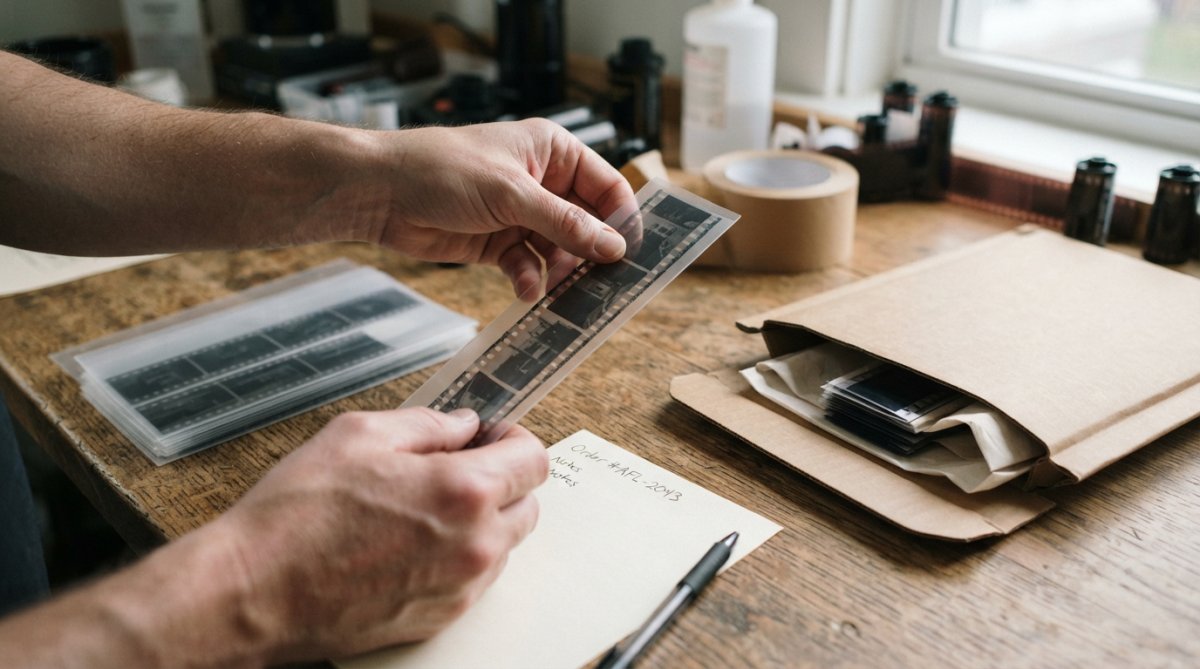
After placing your order with us, use the address and order number supplied in the confirmation. Write the order number on a sheet of paper and include it inside the parcel.
Choose a service appropriate to the value of your material. Tracked shipping helps you monitor delivery; for unique or irreplaceable images, consider signed-for service and check available insurance.
Insured and signed-for shipping: when do you need it?
Signed-for shipping is worth considering when the images cannot simply be taken again, such as family photographs, documentary work or client assignments.
A signed-for service generally combines tracking with confirmation of delivery. The exact tracking events and delivery conditions depend on the carrier and chosen service.
Additional insurance may be available for valuable shipments. Compare the carrier's terms, exclusions, maximum compensation and evidence requirements carefully. The sentimental or creative value of unique photographs may not be covered.
Shipping risks and how to reduce them
Postal journeys involve sorting machinery, pressure from other parcels and changing temperatures. Here are practical scenarios and ways to protect your film.
Risk 1: bending and creasing during sorting
Bending is a major risk. Envelopes pass along conveyors and through sorting machinery, where a thin flexible package may crease. The outside can appear intact while the negative inside has a permanent fold.
Prevention: the packaging needs to be rigid. Even a 300 g/m² cardboard envelope can bend under pressure. Add two layers of rigid cardboard or use an envelope with corrugated reinforcement. Check the rigidity of the empty packaging before putting film inside. If it flexes easily, add stronger support or use a box.
Risk 2: concentrated pressure and compression
Other parcels can press on your shipment during transport. A particular risk is concentrated pressure, such as the corner of another box pressing into a small area. It can cause a dent or tear even when most of the envelope remains intact.
Prevention: add a cushioning layer around the supported contents. Place bubble wrap around the rigid cardboard bundle, never directly against a bare negative. A box offers better resistance to concentrated pressure.
Risk 3: moisture and condensation
Moisture can cause serious damage. Rain is an obvious source, but condensation caused by temperature changes is another risk. Moisture can warp cardboard and cause emulsion to stick to its sleeve.
Prevention: a water-resistant outer bag helps protect against rain. For suitable dry material, a small silica gel sachet can help manage moisture inside the package. Keep it outside the film sleeves and do not let it touch the negatives.
Risk 4: loss and delivery errors
Loss is difficult to predict. An address may become unreadable or a label may detach. Even an unlikely loss can have serious consequences.
Prevention: alongside tracking, take one simple extra step: include your return address INSIDE the package, on a separate sheet with your name and order number. If the outer packaging is damaged, these details may help identify or return the contents.
Risk 5: heat
Extreme heat can damage film. A parcel left for hours in a hot vehicle or direct sunlight may reach temperatures that affect the emulsion. This is particularly relevant in summer.
Prevention: avoid unnecessarily slow shipping during hot weather. Reducing transit time can reduce heat exposure, though it cannot control transport conditions.
Storing negatives: from shipping to archiving
Good storage starts with a cool, dry and dark environment. Do not use the shipping envelope as permanent storage: transport packaging and archival packaging serve different purposes.
Use suitable photographic archival sleeves in a supported binder or archival box. Avoid heavy stacks that compress lower strips (archives.gov). For home collections, choose the coolest practical location with stable conditions. Particularly valuable or deteriorating film may benefit from specialist storage advice.
Label sleeves so you know which photographs they contain. A well-organised archive saves hours of searching later. Keep elastic bands and paper clips away from the film because they can leave permanent damage.
What happens on arrival: film developing by post
At Analog Film Lab, your order number helps us register and identify the shipment. Film is checked for visible problems before processing starts.
Mail-in film developing follows the process appropriate to the film type, followed by drying and any ordered scanning. We use professional Noritsu HS-1800 scanning equipment. Digital files are delivered through the download service, and negatives are collected or returned according to your order. Already-developed negatives sent for scanning do not need developing again.
Turnaround depends on film type and service. At Analog Film Lab, regular C-41 and black-and-white orders usually take approximately 1–2 working days after receipt. Special processes may have a different schedule. Allow extra time for shipping.
Common mistakes when posting negatives
A common mistake is using a plain paper envelope without rigid protection. Negatives can be bent or crushed during sorting. Use rigid support and suitable outer packaging.
Another mistake is sending negatives without individual sleeves. Loose strips rub together and develop fine scratches that may become obvious in larger scans or prints.
Leaving out the order number also causes delays. The lab then has to identify the shipment manually. Put a clear note with your order number and contact details inside the parcel.
These precautions reduce the risk of damage and help you track delivery. Good packaging is a small investment compared with losing photographs that cannot be recreated.
Safe shipping takes care at every stage, from protective sleeves to your choice of postal service. At Analog Film Lab we understand that your images are irreplaceable and handle each shipment with care, drawing on Foto Americaine's photographic heritage since 1906. Select your film type and service online, then follow the order instructions to send your material. CHOOSE YOUR FILM & OPTIONS →
Frequently asked questions
Can I send negatives in an ordinary envelope?
We do not recommend it. A plain envelope offers too little protection against bending, moisture and abrasion during postal sorting. Use suitable archival sleeves, rigid support and a sturdy envelope or box to keep the film protected.
Is it safe to post original negatives?
Appropriate packaging can greatly reduce the risks, although shipping is never risk-free. Put negatives in archival sleeves between rigid boards inside sturdy outer packaging. Use tracking and consider signed-for or insured shipping after checking the cover and exclusions.
Do I have to use signed-for shipping?
It is not compulsory, but worth considering for valuable or irreplaceable negatives. Tracking and delivery confirmation provide more visibility. Any claim for loss or damage depends on the carrier's terms, evidence requirements and compensation limits.
How do I protect negatives from scratches in transit?
Use sleeves designed for photographic archival storage, such as suitable polypropylene or photo-safe paper. Put each strip in its own pocket and prevent the sleeved bundle from moving inside the package. Cushion empty spaces without compressing the film.